You can listen to the full audio version of this blog we call — Buyer Insight.
When a deal goes quiet and nobody knows why, the first place everyone looks is sales. Did they follow up fast enough? Did they handle the objections well? Did they push hard enough at the close? That scrutiny isn’t unreasonable. Sales is the last function to touch a deal before it dies.
But sales is rarely where the problem started.
Most companies operate on a shared assumption, rarely stated but almost universally held: buyers need information to decide. If they’re hesitating, they need a clearer explanation. If they’re stuck, they need more data. If they walked away, someone failed to educate them properly. Sales absorbs most of the blame when this assumption fails, but sales didn’t invent the assumption. The whole company built its go-to-market motion around it.
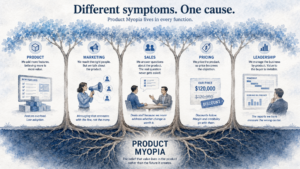
Product teams write detailed documentation explaining what the product does. When a deal stalls, they show the roadmap, as if a buyer who can’t commit to what the product does today will feel better knowing what it might do in eighteen months. Marketing produces whitepapers and case studies designed to inform. Sales gets trained to handle objections with better answers. Proposals get longer. Demos get more thorough. Every function in the company is optimizing for information delivery.
But a lack of information is not the problem.
Buyers hesitate because they lack confidence in a future that hasn’t happened yet. A VP considering a new operations platform isn’t wondering what the software does. She’s wondering what her team looks like six months after implementation, whether adoption will actually happen, and what she tells her CFO if it doesn’t. No amount of feature documentation answers those questions. No roadmap resolves them. The information is there. The confidence isn’t. And without that confidence, willingness to pay never fully forms. The buyer can’t justify a number, internally or externally, for an outcome they can’t yet see.
This is the Information Trap. Product built features. Marketing described those features as benefits. Sales learned to present those benefits in sequence. Each step made perfect sense on its own. But together they produced a go-to-market motion that forces the buyer to translate all that information into a believable picture of their own future. That translation is hard, often impossible. And when companies only provide information, they make this entirely the buyer’s problem to solve.
The exit from the Information Trap isn’t a better pitch or a sharper deck. It’s a different understanding of what buying actually is. Buyers are making a prediction about the future, not an evaluation of the present. Confidence in that future is what closes deals, and that confidence comes from something fundamentally different than information.
That shift in understanding has to happen across the whole company. Not just in sales.
Share your comments on the LinkedIn post.
Now, go make an impact!
 Tags: b2b, b2b buying, buyer, buyers, decision gap, decision making