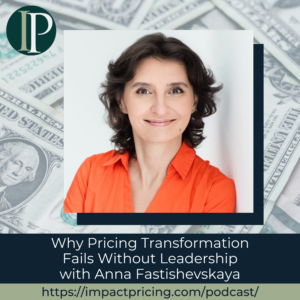
What if the biggest obstacle to pricing transformation isn’t the pricing strategy itself, but getting people to change?
Anna Fastishevskaya leads commercial finance and pricing for Eaton across EMEA, bringing experience in finance, commercial strategy, profitable growth, and pricing transformation. She also has an unexpected perspective on leadership: she’s a theater actress who uses acting techniques to help people communicate, connect, and lead change.
In this episode, Anna explains why pricing needs a seat at the leadership table, how companies can move beyond selling products to delivering customer value, and why trust, transparency, and stakeholder alignment are essential to successful pricing transformation.
Podcast: Play in new window | Download
Why you have to check out today’s podcast:
- Discover why pricing should be positioned at a senior level and connected to the broader revenue generation strategy.
- Learn how pricing leaders can help teams embrace change, align stakeholders, and communicate customer value more effectively.
- See how theater techniques can help leaders tell better stories, connect with their audience, and lead transformation without losing authenticity.
“Plan early for different types of scenarios and play transparently with the customers and the stakeholders so that the trust is really being built. The biggest thing that everybody hates is surprises.”
— Anna Fastishevskaya
Topics Covered:
02:00 – From Commercial Finance to Pricing Leadership. How Anna’s background in finance and profitable growth prepared her to lead pricing transformation.
03:30 – Why Customer Value Comes Before the Price. Why building long-term customer relationships and delivering value matter more than simply closing today’s order.
05:00 – Who Should Own Pricing? Why Anna believes pricing should have a seat at the senior leadership table and be part of a broader revenue generation strategy.
09:00 – The Challenge of Selling Value Instead of Products. Why manufacturers need to identify monetizable customer value and bring customers along on the journey.
11:00 – Why Pricing Transformation Needs Leadership. How leaders can help teams adapt when expectations for results move faster than people’s ability to change.
14:30 – What Theater Teaches Us About Leadership. How Anna uses acting and audience feedback to sharpen communication and make business stories clearer and more impactful.
19:00 – Why Pricing Teams Need Emotional Intelligence. How empathy, stakeholder alignment, and leadership engagement help pricing teams succeed across an organization.
20:30 – How to Tell a Story That Connects. Anna shares a practical coaching technique: develop a short personal story tailored to your audience to create a stronger connection.
23:30 – The Pricing Advice That Builds Trust. Anna’s advice on planning for different scenarios and communicating transparently with customers and stakeholders.
Key Takeaways:
“We cannot succeed in isolation. This is the teamwork from the broadest perspective of organization.” – Anna Fastishevskaya
“Plan early for different types of scenarios and play transparently with the customers and the stakeholders so that the trust is really being built.” – Anna Fastishevskaya
Connect with Anna Fastishevskaya:
Connect with Mark Stiving:
- LinkedIn: https://www.linkedin.com/in/stiving/
- Email: [email protected]
Full Interview Transcript:
(Note: This transcript was created with an AI transcription service. Please forgive any transcription or grammatical errors. We probably sounded better in real life.
Anna Fastishevskaya
Plan early for different types of scenarios and play transparently with the customers and the stakeholders so that the trust is really being built. The biggest thing that everybody hates is surprises.
[Intro]
Advertisement
Every year, the best pricing and commercial strategy minds in the world find each other in one place. This November, that place is Amsterdam. EPP is celebrating 20 years by bringing 1,000 pricing and RGM leaders together for its global summit, November 17th and 18th.
If pricing is your profession, this is where you belong. Register at pricingplatform.com.
Mark Stiving
Welcome to Impact Pricing, the podcast where we discuss pricing, value, and how buyers decide.
I’m Mark Stiving. I help companies turn hidden value into willingness to pay.
Our guest today is Anna Fastishevskaya. How’d I do?
Anna Fastishevskaya
Very good, yes.
Mark Stiving
Thank you. Here are three things you want to know about Anna before we start. She leads the commercial finance and pricing for Eaton across EMEA.
Her career spans finance, leadership, commercial strategy and pricing in complex B2B organizations.
And my favorite thing about her is she’s a theater actress who brings that perspective to leadership and decision-making.
Welcome, Anna.
Anna Fastishevskaya
Thank you very much, Mark. Happy to be here with you.
Mark Stiving
It’s going to be a fun, well, I’m sure it’s going to be a fun conversation.
How did you get into pricing?
Anna Fastishevskaya
Pricing, I consider myself as an outsider to pricing because I joined pricing community quite late in my career, maybe directly leading it just about two years ago.
But I don’t come unprepared. I have experience in commercial finance, quite broad experience, and as you mentioned earlier, in driving the profitable growth throughout different organizations.
So when pricing was added to my portfolio, it was a natural move for me to go into that direction and to really lead the transformation that we are doing to put pricing in the right place in the organization.
Mark Stiving
Nice.
So when I think about finance, and please, I’m not trying to offend you by any means, but when I think about finance, I tend to think that they are more in the cost plus range.
And when I think about product or product managers or marketing or pricing, I think we should be focused on the willingness to pay phase, right? How much is a buyer willing to pay?
Did you find you had to shift your thinking? Did you shift your thinking as you move from finance into pricing?
Anna Fastishevskaya
So for me, this was not a challenge, actually. Why?
Because I do put myself in the shoes of the customer to start with. So naturally, commercial finance looks at the customer, not so much from the perspective of how much the customer pays, but I’m looking into the customer to come back to me, not just place this order today, but do business with me.
And for the customer to do that, they want to have trustful relationship. And that comes from being delivered the value they need, right?
So for myself, it was not that much of a challenge, but I do see that people within finance organization who would come from product based finance background, it would be quite tough for them to make that shift. Yes.
Mark Stiving
Yeah, so typically when I think about pricing, by the way, I love exactly what you just said.
Typically when I think about pricing is I think the number one thing that matters is what’s my buyer willing to pay.
But it turns out that I influence that by figuring out how do we deliver value, right? So it’s all about value to the customer.
And so when you start thinking about relationships, that’s part of the value story. How do we build value with the customer? And obviously not cheating them or gouging them in pricing.
Anna Fastishevskaya
No, no, no, not at all.
Especially that it depends on the industry as well, right? Right now I work in the B2B industry, as you mentioned, and we are both delivering products and solutions.
So you can look at those both business models even very differently. And the value that is created to the customer is different there as well.
So putting that into consideration for any pricing decisions or commercial finance decisions is critical. Yeah.
Mark Stiving
Yeah, nice, nice.
Okay, so now I’m going to ask you the easy question that absolutely nobody knows how to answer. Who should own pricing?
Anna Fastishevskaya
An easy answer to that would be everyone. My personal belief is that pricing should be positioned at the highest level in the organization.
Doesn’t mean CEO for a big multinational, but definitely on the regional level, I would love to see pricing sitting at the table of the president of that specific regional or the company.
This is my personal opinion.
Mark Stiving
Well, I love the opinion. I love the thought process.
In a lot of companies, we see a chief pricing officer nowadays, which is kind of interesting.
Anna Fastishevskaya
Yeah. We even start seeing value creation officers from what I know, which is a step maybe forward or next or so taking pricing, not a way, but embedded in this value notion that we want to see for the customer, right?
So, yeah, there are different developments that we can observe in companies today.
Mark Stiving
Yeah, I like that a lot as well, Chief Value Officer.
And then in SaaS, we see someone called a Chief Revenue Officer often.
Anna Fastishevskaya
Yeah, exactly. Yeah.
In our company today, we’re talking about revenue generation approach and how pricing is part of that and that we move away from just pricing per se in terms of tactics to thinking broader about revenue generation.
Yeah. So.
Mark Stiving
Yeah, and so I find it kind of fascinating that prior to the most recent times, when you say the word pricing, people think that means I have to put a number on a product.
Anna Fastishevskaya
Yeah, yeah.
Mark Stiving
Right? And it is so much bigger than that.
Anna Fastishevskaya
Absolutely. It is bigger and different as well.
So pricing used to be limited to that tag on a product or some analytics that could be done, right? But now it’s completely different in terms of what value pricing can bring, but it is not that far advanced in the number of B2B companies I worked with in terms of how empowered pricing is still today.
Mark Stiving
Yeah, nice, nice.
So Eaton tends to build hardware products, right? You guys, mostly hardware. Do you have any examples? And by the way, you’re allowed to say Mark, I don’t want to answer that question.
But do you have any examples of products where you’ve moved away from selling the actual product? So let me give you a couple examples real quickly.
So truck tires are often sold by the mile. Or jet engines are sold by the hour of execution. And so it’s no longer selling the product. We’re selling by a different, in SaaS, we call this a pricing metric. I don’t know if you use that word or not at Eaton.
Anna Fastishevskaya
Yeah, I see what you mean.
So we are not there yet, which means that we would love to move to sell that quantified value, but we’re not there yet. We’re still very much manufacturing company and we are selling the products.
We have the ambition to sell the value to the customer, but that’s work in progress. Yeah.
Mark Stiving
Yeah. And it takes a lot of work. It takes a lot of creativity and then you’re going to have to change your billing and you’re going to have to change your thinking. It’s a huge thing to do.
Anna Fastishevskaya
Yeah. You need to identify the value for the customer that can be monetized. Right.
And this is a big work and it is not a journey that can be done just by the manufacturer itself. This is something where we need to take our customers with us as well. Yeah.
Mark Stiving
Yeah, it feels like a big bet and a big challenge. So I was just very curious.
Anna Fastishevskaya
And an opportunity as well, because once you can lead that on the market, there is definitely something to do and to get value both for the customer and for the company, especially within our volatility and dependency on the inflation or, you know, any type of recent headwinds that we have. Yeah.
Mark Stiving
Right.
And, and that’s why these companies do it is because it’s good for both them and for their customers.
Anna Fastishevskaya
Yeah. Absolutely. Yes. Yeah.
Mark Stiving
That’s awesome.
Okay. Let’s talk about, do you want to talk about leadership or do you want to talk about theater or do you want to talk about both at the same time?
Anna Fastishevskaya
Yeah, we can, we can combine that because it’s a, we cannot separate both. Let’s talk about leadership and how theater helps with that. Yeah.
Mark Stiving
Please, please.
So how, first off, do you have a leadership philosophy that we’re going to follow and then we’ll see how theater plays a role?
Anna Fastishevskaya
So we definitely have the change in leadership expectations, let’s put it that way, towards privacy.
And as I mentioned, the expectations are extremely high to deliver yesterday on very big numbers, let’s put it that way.
At the same time, the speed of change did not evolve at the same pace as the expectations. What I want to say there is that we are still humans and people cannot just wake up in the morning and become somebody very different.
So this is where taking any type of action or any type of communication, making those personal and targeted to the emotions of either people on their leadership team or broader teams that we have in the organization to go with us on the pricing transformation is extremely important.
And this is where I get the help from the theater because this, we call it
Mark Stiving
Hang on, hang on one second, Anna. I want to come back to the theater in just a second, but I want to add something to what you just said.
Anybody who has become a leader in a large organization has done so by being successful at being who they are. And so now you’re saying to them, I need you to change, right? And so that’s really, really hard because what they are is what’s driven their success.
Anna Fastishevskaya
Yeah, this is a hundred percent right. And actually we just discussed it earlier within the leadership team here as well.
So people who come to a play and say, ‘I am who I am and that made me successful’.
Will not make success for the future because within the changing world that we live in, it is this adaptability to change that makes us evolve and become better and better leader, right?
So that openness, that willingness to change is part of the leadership skills I would say, personal opinion, that this is one of the most important competencies that we will be having in the future, coupled with critical thinking and curiosity.
Mark Stiving
Nice. I actually think that’s really insightful. I love that.
And just to add on, I work with a bunch of different companies, and I don’t work with companies who don’t want to change.
Anna Fastishevskaya
Yeah.
Mark Stiving
Right? It’s like, why am I doing this? It just makes no sense to me.
Anna Fastishevskaya
Yeah, exactly.
Mark Stiving
And it’s always the leadership that has to say, hey, we want to go do something different. How do we learn?
Anna Fastishevskaya
Yeah, but those are, I don’t want to say that it’s easy. Those are difficult conversations that we have.
And on my own example, one of the top requests from my own team of commercial finance and pricing people used to be, Anna, we have so much change ongoing everywhere. We just want a little bit of stability.
And this is where I come as a leader and I’m like, what do I do with that request? Right?
Because I know very well that any stability is actually going backwards today.
So for us, even only to keep with the pace of change, we need to move fast. And if we want to be on top of that, we need to move even faster.
And this mindset shift to go from the request for stability into accepting and even enjoying the change is something that is critical and that I see leadership playing a very important role in engaging broader teams that we have. Yeah.
Mark Stiving
Nice. Okay, and so now let’s talk specifically since you mentioned a pricing transformation.
And how is it that theater helps in a pricing transformation?
Anna Fastishevskaya
Yeah, so this is a personal journey.
I started theater formally around five or six years ago. I was looking for an activity for my children, actually, and then I realized, I insist so much, maybe I need it for myself.
So this is how it all started. And the performance on stage where you can see people’s reaction immediately to what you’re saying or acting is like direct feedback that can be received.
It is very valuable as a competency because that feedback can be something that you like and can be something that you don’t like, but definitely you cannot ignore it.
So what happens is that with the experience, the story that is being told from stage becomes crisp, becomes clear and targeted to the audience as well.
And those are all the techniques that can be taught. So it is not, yes, there are talents, there are like spectacular people who know how to do that naturally. But my purpose at work is to demystify some of those techniques so that people in my organization can take them because I can translate these acting techniques to the business world and just play with them so that people feel better.
Especially, I started introducing that to my finance community who would come from mainly accounting backgrounds or less so exposed to external customers, et cetera. And they felt the need, but did not have that easy access to those techniques.
With pricing, it was much easier for me because usually people within pricing community, they already come with some marketing background or sales or so it’s much more diverse and open for experimentation. Yeah.
Mark Stiving
Nice. Nice. Okay. So let me ask, first off, I just want to talk about theater. I didn’t expect an actor to be watching the audience and adjusting to the audience.
I expect the actor to be responding to what the director tells them to do. So I was actually surprised that you said that.
Anna Fastishevskaya
Okay, maybe that belongs to different acting philosophies.
Mark Stiving
I have none, so don’t worry.
Anna Fastishevskaya
Yeah, because in my case, I’m not imposed to do things that I don’t believe in or, you know, like to take on a role that would not fit my personality.
I’m creating my own stories as well that I can tell so that it is a kind of co-creation with the theater directors I work with.
And within any type of play or performance that we are staging, there is space for that personal touch to make it mine so that it remains authentic. And that is important to work as well.
In the pricing journeys and leadership conversations is remain authentic to yourself. Even if today I take the pricing leader, a role tomorrow, commercial finance leader role, and there may be some conflicts, but still there are those underlying values that are important to stay consistent with the mask. If you see what I mean.
Mark Stiving
Yeah, I understand exactly what you mean. And so now let’s bring this back to leadership or business for a second.
I don’t want to diminish what you said, but it seems to me like what you said was we need to have empathy and we need to have emotional intelligence.
Anna Fastishevskaya
As a minimum, all types of intelligence, but yeah, those minimum requirements, let’s put it that way to the pricing teams that I have.
And actually while interviewing for different roles that we would have in the company, I see that theme coming across very often and naturally from experienced pricing professionals. Which they put different words to that, right? They don’t necessarily say empathy or emotional intelligence, but like stakeholder alignment or leadership engagement, making sure that our story is heard and that we have the necessary sponsorship.
So all of that is around to the same, that we listen to our external customers and internal stakeholders as well to come up with the best solution within pricing organization. We cannot. succeed in isolation. This is the teamwork from the broadest perspective of organization.
Mark Stiving
Yeah, I could not agree with you more. That was, that was perfect. How do you teach this?
Okay, so real quickly, I’m an engineer by heart, right? I was a geek and I did not understand people.
You’ve probably heard the joke, do you know how to tell an extroverted engineer? He’s the one who looks at the other person’s shoes.
So it took me forever to learn how, and I don’t want to say read people, but it’s like, maybe even it’s care, right? To even care what other people think.
Anna Fastishevskaya
Yeah, yeah.
So I usually start with myself or yourself if you are the person I coach. Why? Because it’s easier to talk about yourself rather than listen first, right?
So I would start asking you to come up with the story about yourself. that could fit two, three minutes maximum, and that could impact me, and I can explain to you a couple of words about myself, so that we could connect.
And then we would have a debrief session because you preparing your story to fit my audience is already the first step into listening and into trying to be receptive and to impact me, right?
And then we can move on from that journey to more listening and to more engagement with their audience, et cetera, et cetera. But like, it is a bit of a trick to start the conversation.
Mark Stiving
Okay, so now I’m playing back the conversation we just had.
I just told you, you’re now my coach, right? I just told you a story about me being an engineer and not caring about other people.
Anna Fastishevskaya
Yeah.
Mark Stiving
Is that exactly what you’re talking about or is it something else?
Anna Fastishevskaya
I would ask you to go a little bit deeper in that.
But that’s a good start because here you, in a way, you open yourself already with vulnerability of acknowledging that you don’t care about people, right? It’s not something that people would easily put up.
So I can already relate to your story. I would just ask you to go a little bit with details around it to bring up a case from the past where you experienced it and how it turned out, so to have some techniques to evolve to get to some culmination point where I could feel really connected to that instead of just a couple of words, but absolutely yes.
Mark Stiving
Okay. I do have stories for you, but I’m not going to share them today.
Anna Fastishevskaya
That’s for another conversation.
Mark Stiving
And I do want the audience to know I actually care about people now, so it’s okay.
Anna Fastishevskaya
Yeah.
Mark Stiving
So Ana, this is fast. I am having so much fun talking to you, but we’re going to run out of time.
Can I ask you the final question?
And maybe you don’t like it, but I don’t really care. What is one piece of pricing advice you’d give our listeners that you think could have a big impact on their business?
Anna Fastishevskaya
Pricing advice would be to plan early for different types of scenarios and play transparently with the customers and the stakeholders so that the trust is really being built.
The biggest thing that everybody hates is surprises. So playing transparently is important in pricing.
Mark Stiving
Nice. I find that trust thing and transparency thing, take it one step further. If you think I’m actually looking out for you and not looking out for myself, then you really build that trust.
Or looking out for you while I’m looking out for myself, I guess would be a better way to say it, right?
Because then it would be truly trustworthy. This is fascinating. I do actually have to ask you one more question. What are you going to talk about at EPP20? I know you’re going to be at EPP20, so what are we doing?
Anna Fastishevskaya
So I’ll be joining the team there, we’ll be talking about the pricing transformation.
And I will be actually sharing my journey there, both some challenges that I faced personally as a leader, as an individual coming as an outsider and within the companies. And the early successes as well, because that’s important to share how those challenges can be overcome or not. How do we live with that, but still consider it as a learning opportunity and a success.
Mark Stiving
Nice. And I understand you’re also going to give your best Hamlet delivery from the stage too.
Is that right?
Anna Fastishevskaya
Not a Hamlet, but something different. Yes. Yes, definitely. It will be fun.
Mark Stiving
Anna, thank you so much for your time today. If anybody wants to contact you, how can they do that?
Anna Fastishevskaya
Yeah, they can definitely check my profile on LinkedIn and I’ll be happy to engage in conversations and yeah, have further discussions around pricing and theater.
Mark Stiving
And theater. And we’ll have your URL in the show notes so people can find you relatively easily. Good.
To our listeners, thank you for your time today. If you enjoyed this, would you please leave us a rating and a review?
And finally, if you have any questions or comments about the podcast, or if you want to see value through your buyer’s eyes, email me, [email protected].
Now, go make an impact.
[Outro]