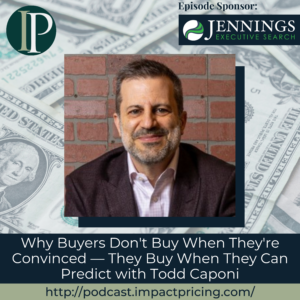
 Todd Caponi is the author of The Transparency Sale, The Transparency Sales Leader, and The Four Levers of Negotiating. He advises revenue teams on decision science, transparency, and how buyers actually make decisions.
In this episode, Todd challenges one of the biggest assumptions in business: that more information leads to better decisions. Drawing from buyer psychology and real-world sales research, he explains why buyers actively seek out negatives, why perfect pitches create skepticism, and why transparency accelerates trust.
Podcast: Play in new window | Download
Why you have to check out today’s podcast:
- Discover why more information often makes buying decisions harder.
- Learn why buyers seek out negatives before positives and how transparency can increase trust, shorten sales cycles, and improve win rates.
- Master the shift from persuasion to prediction so buyers feel confident moving forward instead of getting stuck in analysis paralysis.
“We don’t buy when we’re convinced. We buy when we can predict.”
— Todd Caponi
Topics Covered:
01:03 – Why Negotiating Pricing Feels So Unnatural. Todd shares the negotiation breakthrough that led him to embrace transparency instead of traditional sales tactics.
05:18 – Why Buyers Trust Imperfect Solutions More Than Perfect Ones. The consumer research that changed Todd’s thinking—and why buyers actively seek out negatives before making decisions.
08:50 – Transparency vs. Honesty: The Difference That Changes Sales Outcomes. What transparency really means and how proactively sharing weaknesses can accelerate trust.
12:15 – The Long Game Wins the Short Game. A debate on incentives, trust, and whether transparency actually benefits individual salespeople.
15:11 – Do Buyers Make Emotional or Logical Decisions? Todd explains why feelings often drive decisions before logic enters the picture.
20:24 – Why B2B Buyers Still Behave Like Consumers. Buying committees, RFPs, and the hidden emotional biases behind supposedly rational decisions.
25:14 – Buyers Don’t Buy Products—They Buy Predicted Futures. Mark introduces a powerful framework for understanding how buying decisions really happen.
31:42 – More Information Doesn’t Help Buyers—It Makes Decisions Harder. From mail-order catalogs to AI, Todd explains why information overload increases decision friction.
32:35 – The Case for Radical Pricing Transparency. Todd’s practical framework for pricing conversations built around volume, commitment, cash flow, and predictability.
Key Takeaways:
“Transparency is without asking, I’m going to tell you the truth.” — Todd Caponi
“The long game wins the long game—but it wins the short game too.” — Todd Caponi
“More information has never made buying easier. It’s always made it harder.” — Todd Caponi
“True salesmanship is the science of service.” — Todd Caponi (quoting Arthur Sheldon)
Resources Mentioned:
- Arthur Sheldon – Early sales philosopher and author of The Art of Selling (1911), whose principle that “true salesmanship is the science of service” remains relevant today.
- António Damásio – Neuroscientist and author of Descartes’ Error, referenced during the discussion on emotion, logic, and decision-making.
- Northwestern University Research – Consumer behavior research that revealed buyers actively seek out negative reviews and trust products with balanced ratings more than perfect scores.
- The Transparency Sale – Todd’s bestselling book exploring how openness and honesty accelerate buying decisions and improve sales outcomes.
- The Four Levers of Negotiating – Todd’s latest book on transparent negotiation and value creation.
Connect with Todd Caponi:
- Website: https://toddcaponi.com/
- LinkedIn: https://www.linkedin.com/in/toddcaponi/
Connect with Mark Stiving:
- LinkedIn: https://www.linkedin.com/in/stiving/
- Email: [email protected]
Full Interview Transcript:
(Note: This transcript was created with an AI transcription service. Please forgive any transcription or grammatical errors. We probably sounded better in real life.
Todd Caponi
I believe in the power of transparency as it relates to delivering, proposing, and negotiating your pricing.
[Intro]
Advertisement
Today’s podcast is sponsored by Jennings Executive Search. I had a great conversation with John Jennings about the skills needed in different pricing roles. He and I think a lot alike. If you’re looking for a new pricing role, or if you’re trying to hire just the right pricing person, I strongly suggest you reach out to Jennings Executive Search. They specialize in placing pricing people. Say that three times fast.
Mark Stiving
Welcome to Impact Pricing, the podcast where we discuss pricing, value, and how buyers decide.
I’m Mark Stiving, and I help companies get paid for value their buyers can’t see.
Our guest today is Todd Caponi.
Here are three things you wanna know about Todd before we start.
He is the principal of SalesMellon LLC, where he advises revenue organizations on transparency, decision science, and revenue growth. He’s a multi-time C-level sales leader who helped lead two companies through successful exits.
And he’s the award-winning author of The Transparency Sale, The Transparency Sales Leader, and the newly released Four Levers Negotiating.
Welcome, Todd.
Todd Caponi
It’s great to be here. Can’t wait to dig in.
Mark Stiving
I’m having a hard time reading today. Let’s just talk. Is that okay?
Todd Caponi
I have a hard time reading most days.
Mark Stiving
So first, I always ask this question. I’m going to ask you, even though it really doesn’t apply, how did you get into pricing?
Todd Caponi
Well, I got into this accidentally, meaning I’ve always been kind of, I guess, soft when it comes to selling, meaning I want to build a relationship. I want to help a customer achieve an optimal outcome.
And what I always was terrible at was talking about, and then especially negotiating pricing, And it’s based on this concept that I always felt like it was weird that we’ve been taught to change personalities when it’s time to talk pricing and time to talk negotiating.
Meaning we build trust, we’re focused on customer outcomes, we get them to the goal line, customer says yes, so then we at least subconsciously have been taught to go, all right, cool, I’m going to start lying to you now.
Not going to tell you what a good deal is. You got to figure that out.
And oh, by the way, I learned all I know about negotiating from former FBI hostage negotiators like that. I was terrible at. I’m a terrible liar.
And we’ll talk through this here in a minute. But I had gotten into kind of a high stakes B2B negotiation back in 2008, when I’d first gotten promoted into being a revenue leader.
And I accidentally kind of went blah and just played my cards face up and magic happened. And that became really my impotence behind, wait, we don’t have to have this anxiety. We don’t have to erode trust of the goal line.
We don’t have to discount so much. We can forecast more accurately. And so it became more of a passion. And I’ve been nerding out on this for about 18 years now.
Mark Stiving
Nice. I absolutely love that.
So I’ve been in pricing for a very, very long time. And I used to try to sell keynotes and things like that. And, and it, and when you’re trying to sell a keynote, it’s hard to lose a deal. And the entire world changed for me when I just said, I don’t really care if I win or not. Right?
I’ve retired. I don’t really care. Right. So I’m here to help you. Here’s the price. Here’s what it takes. Do you want it or not? Totally fine.
And so how does that resonate with what you’ve realized?
Todd Caponi
Yeah, I think I’ve realized that caring about deals where you really feel that you can make an impact and help a customer achieve an outcome maybe they’ve never thought possible is one thing, but it’s another thing to make sure that you care when you’re not a good fit.
You care very quickly that, hey, listen, if I were in your shoes, I wouldn’t like this, and I wouldn’t like this, and I wouldn’t like this.
If those resonate, let’s talk about that now versus later.
And it really comes down to, especially with these companies that I work with, they’re RFP driven. They get these RFPs and they’re like, gosh, we’re not a great fit for that. And the greatest thing in the world, Mark, to what you just said, is when they take that attitude to go, hey, I actually think it’s a better idea if we lose this.
The minute they own that transparently to the customer and go, hey, listen, based on what you’ve written here, You got a couple of good options. I hope you sent the RFP to them because they’re better than us in this situation.
And so often that magnetizes them back. They’re like, wait, what do you mean? We reached out to you because we’ve heard great things. That’s happened in my own business multiple times too, where people reach out to me and they’re like, Todd, we could really use some prospecting and cold calling help. I’m like, we talked through it. I’m like, cool. I could help you there, but if you made a list of the top 50 people that do it, I’d come in at about number 47.
Can I get you in the hands of the top three or so and let’s move on with our lives?
And so often that’s brought them right back to wait, what is it you’re good at? Why do people pay you? And I end up getting engagements anyway through that.
Mark Stiving
So that’s pretty fascinating.My answer is…
Todd Caponi
You want to win and make sure that you care enough to share the deals that you should be losing quickly.
Mark Stiving
I was gonna say, my answer is I just don’t reply to RFPs, right? If you send me an RFP, I’ll just say, no, thanks. And then oftentimes they just call me and say, okay, let’s talk, what do you do?
Todd Caponi
Yeah, exactly. That’s right.
Mark Stiving
So, okay. I am fascinated by this word transparency that you use.
And first off, let me just leave it there. And then I’m gonna tell you what I hate about the word transparency.
Tell me what you mean when you say transparency.
Todd Caponi
Yeah, because it’s an overused word. It gets mixed up with honesty and authenticity. I believe those are three completely different definitions. So here’s transparency.
My last role, I was the chief revenue officer of a company based in Chicago called Power Reviews. Probably never heard of it, but you’ve used the technology if you buy stuff online.
So we were the engine behind the collect and display of reviews on a thousand different retailers’ websites, like Crocs and Vineyard Vines and a bunch of others.
What happened was my marketing team partnered with Northwestern University just to look at buyer consumer behavior when a website’s acting as a salesperson.
Meaning, when you’re going to go buy something you never bought before that matters, what do you do?
And so I thought, it had nothing to do with B2B. Cool. Have fun.
Well, they came back with three data points, two of which changed my life like could only happen to a nerd.
The first data point that didn’t change my life is that consumers, almost all of us, read reviews when we’re going to buy something that matters that we’ve never bought before. We want to hear and understand from the people that are actually using it. Cool.
The two that changed my life, though.
Number one was that at the time, 86% of us specifically seek out the negative reviews, and in most cases, seek them out first.
Meaning we skip the fives, and we read the fours, threes, twos, and ones first. I was like, all right, that’s interesting. I do that. Then the last data point was a product on a five-star scale that has an average review score between a 4.2 and a 4.5.
That’s optimal for purchase conversion, meaning a product that has negative reviews right under it sells faster and more often than a product that has nothing but perfect five-star reviews.
And I looked at that and thought, all right, wait. I’ve got a whole team here that’s selling as though we’re perfect. We’re awesome, they suck. That’s the messaging.
Are we doing it wrong? Are we making it harder on buyers? Does this only apply to when a website’s acting as a salesperson, or does it also apply to when a human is acting as a salesperson?
Well, the answer, as I started digging into the decision in behavioral science, was emphatically the same thing. We, as human beings, at a subconscious level don’t believe in perfection.
And we need to understand the downsides and the risks before we can ever trigger a purchase decision.
And we go to the negative first because basically that reduces the filter on our brain’s decision-making capacity.
And so we started going into engagements talking through, hey, if I’m in your shoes, Here’s what we give up to be great at our core. Here’s what you might not like. Here’s the risk associated with the implementation or the journey.
Our pricing, we’re kind of higher end pricing. Can we discuss that now versus later? We started doing that. Win rates went up partially because we were qualifying in the deals we should be working on. Losing the deals we’re going to lose anyway faster.
Our sales cycle sped up. because we’re adhering to the buying brain and the way that they make decisions. So everything’s sped up.
And then the last piece was we created an extra differentiator, which was differentiating in the way that we sold. And so that’s a long way of coming back to transparency means, hey, cards face up. If I’m in your shoes and I’m trying to make this decision, here’s the stuff that I would care about. The difference between that and honesty, honesty is if you ask me, I’m going to tell you the truth. Transparency is without asking, I’m going to tell you the truth.
And then authenticity is just you being you.
Mark Stiving
Okay.
So here’s what I was going to say before you went into that description was we often hear speakers say…or we hear the whole joke. If I can learn how to fake authenticity, I’ve got it made.
Todd Caponi
Right. Right.
Like if you’re an authentic jerk, then being authentic is probably not the best thing in the world.
Mark Stiving
Right. Right.
And so when we think about transparency, okay. Okay. As a solopreneur, I love being transparent because I don’t want to work for someone who has expectations other than what I can deliver.
Todd Caponi
Exactly.
Mark Stiving
Period. But I can imagine in an enterprise organization, I’ve got salespeople, I’m going to close a deal and let someone else deal with all the lies I told or with all the situations I created.
Todd Caponi
That’s exactly right.
The point here is like, so in some of these old books, you’ll see, I’ve seen quotes about the power of honesty and transparency dating back to the 1790s, believe it or not.
So we’ve always known that being honest and transparent is better than not, but we don’t do it anyway, to your point, right?
Like, hey, I’m focused on getting the deal and getting money in my pocket and everybody else can deal with these problems later.
I had done a keynote on this back during COVID, and I had the chat window open as I’m talking about this idea of the client that reached out to me that I told you about that we’re looking for prospecting help.
And I led with, hey, if you made a list of the top 50, I’d come in at 47 on that. Can I get you in the hands of the top three?
And as I looked in the chat, the individual, somebody wrote, no.
And I was like, hold on. I’m going to stop what I’m saying. Who just wrote no? Let’s have a conversation.
So she comes up, and she’s like, Todd, economy is rough right now. If a client has something other than lint in their wallet, I got to go get it. And so I went into a bit of a rant that when I left the keynote, I remember walking in my kitchen and my wife’s like, were you just yelling at somebody? Maybe.
But what I ended up talking to them about is this idea that, hey, cool, when you win a deal that you’re not a great fit for, where expectations are not aligned, but you won the deal anyway. Like, congratulations.
But I would argue that in this world of the proliferation of information availability on everything we do, buy, and experience, the review proliferation, the ability for peers to connect, the ability for AI to expose the pros and cons for you, that that one deal that you won is likely to cost you four or five deals that you never knew existed, because that grapevine is pretty hard, right?
Because what I asked the woman that had said that is, hey, you won that deal. What happens in six months when they realize that what they bought isn’t what they expected?
And she said, we managed through the dissatisfaction. And I’m like, duh, right? Like that, again, you’re going to lose deals you never knew existed because the grapevine has never been more robust and available to everybody.
The long game wins the long game.
But to this conversation that you and I had, the long game wins the short game too.
Mark Stiving
Yes.
So I’m going to push back. Not that I disagree with your general philosophy, but I want to push back in the sense that that salesperson isn’t affected by the long game as much as they’re affected by the short game.
So if I were that salesperson, what I’d be telling all of my fellow salespeople, be transparent, be honest. Well, I’m not.
Todd Caponi
Right. Yep.
Mark Stiving
So we’re looking at individual incentives and we’re looking at corporate incentives. And there’s zero doubt that transparency helps corporate incentives. But I can certainly see how it goes against an individual salesperson’s specific situation today. Right. I got to feed my family. I got to get this deal closed.
Todd Caponi
Yeah, exactly. I mean, that’s part of the reason why sales continues to drag the bottom of Gallup’s annual ethical and trusted professions list along with politicians, which is where we don’t want to be.
And to your point, like I’ve written about that, that, hey, listen, like the long game wins the long game, but it wins the short game, too, because you’ve got when you set proper expectations, your customers not only stay, but they buy more. They advocate for you. They bring you with them to their next company. That does affect the sales rep.
However, when I travel, one of the things I do, like I’m a sales history nerd, I always, like when I’m going somewhere, try to find something historical as it relates to sales and just kind of check it out.
I was in Amsterdam about six months ago. And, you know, in 1601, 1602, Amsterdam is where the first public stock exchange became a thing.
And I was looking at it, studying it, thinking, to your point, Mark, we know transparency feels good, sells better, retains better, grows better, leads better, negotiates better, yet we will probably never fix it because of what you just said, that those stock markets create such short-termism in terms of investments, like, hey, let’s hit the number and we’ll worry about what happens later, later.
It’s kind of like drive by the Burger King. There’s 15 people in line, right? Like none of those people think that that’s good long-term for their health. There’s not a soul on earth that thinks that, but they’re like, I’ll deal with the stomach cramps later. I’m gonna go now.
Like, that’s just the way we’re wired. This idea of loss aversion is very interesting, but it’s not quite used right. because we as human beings, we will always seek the short-term reward versus the aversion of loss when we know we’ve got time to deal with it and it’s uncertain.
Mark Stiving
Yeah, I’m going to eat that chocolate cake today and start the diet tomorrow.
Totally fine. Totally fine.
Todd Caponi
Yeah. And we know it.
Mark Stiving
Yeah.
Okay. This is fascinating. I’m going to slightly switch topics on something else that I think you talk about, and that is emotions versus logic.
So first off, I’ll just toss that out. Tell me, teach me all about emotions versus logic. And then I’m going to totally disagree with you because I’m, because I’m an engineering nerd.
Todd Caponi
Yeah.
I mean, it’s funny. There’s a couple of ways we could go here.
You know, one of the most profound quotes I’ve read on it is from António Damásio .
I can’t remember his first name all of a sudden. António Damásio , he wrote Descartes’ Error back in the late 90s. He’s got a quote that I just love, which is, we are not thinking machines that feel, we’re feeling machines that think. And, you know, you kind of dig through that idea. The way that our brains work is that we make emotional or feeling decisions and we back it up with logic, not the other way around. And when I talk through that lens, there’s a couple of things. Number one, like Damasio breaks down so many of the stories and the science around individuals that there was this guy, Elliot, that he wrote about. Elliot had a tumor on his limbic, which is the feeling center of the brain.
And when they removed it, they kind of disconnected it. And when he came out of it, he seemed fine. However, because the feeling center was not connected properly, he lost the ability to make decisions. He couldn’t even decide to get up in the morning, to get in the shower, what he’s going to wear his whole life. He was married, he had kids, wife left him, the kids left him, they couldn’t figure out what was going on.
When Damasio found him, he was living in the basement of some like drug dealer’s house or something like that. Like his whole world fell apart and they had discovered that it had to do with that feeling center of the brain.
Last piece I’ll say on that is why I think it’s so important is so many organizations, especially in our formal messaging, We, what I refer to as like, we, we, we all over the customer with logic.
Like, hey, we believe in this. We have won all of these awards. This is why we are so great. We have all of these customers. We have all of these products. And if you’re in the audience, Last point here, we’re going to go back to 1620. Sir Francis Bacon, he was the guy in 1620 who theorized the concept of cognitive bias or confirmation bias, that once we’ve established an opinion on something, we take in all data and logic to support that opinion.
Whether or not that data or logic actually supports our opinion. And you can think about the political ramifications of that, that we can logic all over people that are leaning one way or the other. Doesn’t matter. It actually hardens them. It does not bring them together.
Logic, stories, motion, that’s what brings us together.
So that’s my rant mark. Have at it.
Mark Stiving
Okay, I got three key points I want to make to this, if I may.
So the first point I would make is, I think I could agree with you 99% in consumer decision-making, right?
In B2B, we actually put together programs to take emotion out of decisions.
We put together buying committees, we put together RFPs, we do as much as we can to say, look, emotion is not going to influence this, it is logic.
Should I pause and let you let you refute that?
Todd Caponi
Yeah, I mean, so you’re right.
You know, thinking about my dad, I think my dad would be 104 if he were still around.
But, you know, back he was always a sales guy, sales leader and three martini lunches and golf trips and going to the lodge with his customers.
And it was all emotion. It was all relationship.
It was all back padding and handshakes behind the, you know, like under the table type stuff.
And so what I’ve seen, you’re right, is so many organizations.
I was out, like my last role, we were selling to a massive retailer out on the West Coast. And I remember we were going to meet with the sponsor at a coffee shop.
And we walk in, and so she orders her drink. I go to pay for it. She’s like, no, like, no, you can’t.
If anybody saw you try to pay for it, you guys would be kicked out of here right away. Like, you cannot buy me even a $2 cup of coffee. Like, oh, gosh, all right, cool.
And so all of these RFP processes and all of these structures have been meant to remove the data and logic. I’m sorry, meant to remove the emotion and the feeling out of these decisions.
I would still argue that we still make emotional leanings as we walk in and we start to create perceptions.
And then we will use all of the additional logic and data. We’re reading an RFP. We’re going through it. I like this company better.
Oh, look at this customer list. This customer list is great. They’re awesome.
That one over there. You know what?
We’re going to be a small fish in a big pond. Are they generalists? These are companies all over the place.
We will start to establish a bias, even as we’re reading the data and logic, and then use that data and logic to support it. I see it over and again. I saw it at that big retailer, too.
Mark Stiving
So I’ll agree with you, and this is something I teach a lot, that although in B2B value is measured in incremental profit, all employees of a B2B company act like B2C consumers.
Todd Caponi
That’s a great way to put it. Yes.
Mark Stiving
So an individual employee is acting like B2C.
And so we’re going to see emotion in their behaviors. There’s no doubt.
Okay. Second thought. You like, in fact, the words that I pulled from your website or someplace was emotions versus rationale. Right.
And so I think people are rational to the nth degree.
And here’s why I say that I make a rational decision based on what I believe and what I know.
And so I am always making a rational decision. Now, maybe what I believe in, what I know is driven by emotion to some extent, but it’s still, what do I believe in? What do I know? Right. So.
Todd Caponi
Yeah, I agree with that.
I think on my web, I probably talk more about emotion versus logic. Right.
And again, like we as human beings, we will make emotional decisions and then use logic to back it up from everything from the short term behavior. Right.
But hey, I know this isn’t a good fit, but I’m going to sell it anyway. That’s my feeling because I’m going to fill my wallet and people can deal with it later.
And then when challenged about it, that rep is going to be ready to logic all over whoever challenges them around why it was a good decision to do.
Like, but that’s that’s just the way we work.
Mark Stiving
Yep.
OK, last comment. This comes from my from my upcoming book, Buyer Disconnect.
And I’ve crafted a way that buyers make decisions. And you can spew all over this if you don’t like it.
But I think there are three big phases that buyers go through.
Actually, one big phase and two other phases.
First phase is notice. We have to notice that we have a problem that says, hey, I’m willing to go search for a solution. I’m willing to go see what happens.
The second phase I call choose.
So this is where I’m comparing alternatives. I’m picking the best one. And by the way, I’m going to agree with you that emotion drives that a ton. The last phase I call commit, right?
So when are you going to take the money out of your wallet? When are you going to sign the agreement? By the way, I just bought a new house and I’ve watched myself go through this, just like, when am I going to sign the agreement?
And so if we think of those three phases, the first one, we as companies don’t have a lot of influence over, right? Someone has to notice they have a problem. There’s some we could do, but not a lot.
Choose is where we spend most of our sales efforts is, let me show you how I’m better than my competitors.
The commit piece, this is where I think we shift from emotions to as much pure logic as we possibly can.
We’re trying as hard as we can to say, look, I don’t want to regret this decision after I’ve made it. I need to be able to defend it to other people. So now I’m at the stage that says, this is pure logic.
Todd Caponi
Yeah, I would agree with that, too.
I don’t think I would conflict with that at all.
The three stages that you talk about, in my second book, I break those down as why change, why us, why now?
But really, that is a evolution of what one of my favorite philosophers on sales of all time, I’m going to hold this picture up for anybody watching.
This is Arthur Sheldon, 1902. He was originally, I believe, the guy, there’s others that argue with this, but that theorized that all buyers go through four stages.
That was AIDA, if you remember that. But it was, they’re first paying attention, then they become interested, then they generate a desire for our solution, and then they take action, right? I know Glen Gary Glen Ross ruined that in 1992, but around that type of environment, where I come from on that is most organizations systemically are creating systems in their organization to get their endorphins from what the sellers are doing, not what the buyers are doing, right?
Like all of their Salesforce stages or their HubSpot stages are based on discovery, qualification, demo, proposal, negotiate, right?
Those are all things we’re doing. No wonder we have such a hard time Forecasting, because all of our predictions are based on what we’re doing instead of recognizing buyer behavior.
So I love your three. I think those are right on.
My philosophy was always to layer in. First go, hey, is what I’m doing now sustainable or do I need to change?
So that’s the why change. Then it’s why you. versus somebody else.
So of all the solutions to that change, who should I be focused on?
And again, emotion, emotion. And then when I’ve made my decision, I got to emotionally back this up. But it does become very logic induced. So I like that take and I fully align with it.
Mark Stiving
Cool. Cool.
OK, I’m going to bring up one more thing. This aligns. I had this huge aha while I’m writing this book and now I’m reading it on your page.
So the way I say it and the big aha I had is that all buying is a prediction of the future, right?
And so it turns out, by the way, all decision-making is a prediction of the future, but all buying is in our world, we think of buying.
And so now how do we help buyers understand or envision different futures?
And that’s the piece that I find fascinating.
Todd Caponi
Yeah, and it’s the original design by this dude, Arthur Sheldon, again, 1902.
I believe he’s the GOAT of sales philosophers, and I talk a lot about him, but he, in his 1911 book, The Art of Selling, has a quote that I just love, and the quote is this.
True salesmanship is the science of service.
Grasp that thought firmly and never let go. Back then, service meant being a partner to the customer and help them see what’s possible, but to help them get into the hands of the right solution as quickly as possible as well.
And that comes through helping them predict.
To your point, I’m holding a book right here from 1910. This is from a guy named Thomas Herbert Russell. This is called Salesmanship Theory and Practice. I’m going to hold this up.
No one’s going to be able to see it. But there’s four words here that are going to crack you up because they’re from 1910. Not 2010, 1910.
Those four words are buyers know more nowadays. Buyers, know more.
Back then, the rise of mail order catalogs, the proliferation of advertising meant, what do we need salespeople for anymore? You fast forward to even 2015. Forrester, 2015, came out with a report that said by 2020, a million B2B sales jobs would go away, and hundreds of thousands of college students wouldn’t graduate into the profession.
Why? because buyers knew more. E-commerce was on the rise, and we wouldn’t need salespeople for it anymore.
AI, we’re seeing this all over again.
Where I come from on this is more information has never made it easier on buyers. It’s always made it harder, always, every single time. That’s why the best salespeople are the ones that, through your point, Mark, are the service-oriented ones that come in and go, hey, I can empathize with what you’re trying to achieve here. If you’re gonna work with us, here’s the cons and the pros.
Here’s what we give up to be, we’re not all things to all people.
And so I’m going to, again, attempt to help you predict because we don’t buy when we’re convinced, we buy when we can predict.
And so I’m going to give you the tools and I’m gonna, so you don’t have to go do all that homework. here. And that’s when we become the trusted advisor. That’s when we earn the right that when a customer is bashing us, they come to us instead of just believing them, because we’ve already bashed ourselves. That’s what service is.
That’s what’s helping to predict is empathetically being able to see through the lens of the customer. Last point on that, I just was teaching a leadership program yesterday to about 40 leaders from different companies.
And one of the things that I preach is if your reps, if your sales reps wake up every morning and they get a customer or target list, and it’s 10 different industries, 10 different buyer personas, it’s really hard to do that.
Because you can only be an expert on your own solution. I’m a believer in at least doing firmographic sprints where you teach your reps like, hey, for the next six weeks, we’re going to learn everything about aerospace and defense companies.
What do they care about? Their headwinds, their tailwinds, where they go to get smarter about their businesses and their roles, how they’re measured, all that stuff.
And then suddenly we can have that empathetic help you predict lens. Because again, if you’re scattered every single day, it becomes really, really hard to do.
Mark Stiving
Yeah, I think that’s absolutely brilliant. Absolutely.
So I want to tie this back to something you said earlier, and that is how companies wee wee all over themselves. I don’t know if you said it that way, but I did.
Todd Caponi
That’s exactly how I said it. And I stole it from somebody else. So it’s all good.
Mark Stiving
OK, got it. It’s beautiful. It’s beautiful.
But but if you think about it, salespeople are selling futures. I’m sorry, are selling features. Buyers are buying futures. Right.
Todd Caponi
Yeah.
And so the weird analogy that I make when I talk about this stuff and teach it.
And you’re going to think I’m nuts if you don’t already. If you’ve ever watched a reality makeover TV show, like Restaurant Impossible, Biggest Loser, Bar Rescue, Extreme Makeover, Queer Eye, they all follow a choreography.
And that choreography is they show up.
And these people have volunteered in every one of these cases, right? That, hey, I need help. I need to be made over. My house, my bar, my restaurant, whatever it is, they’ve applied, right?
And in the B2B world, it’s the same thing.
We’re not Zoom bombing people or barging in the conference rooms. These people have said, yes, teach me.
So what happens at the beginning of those shows? They align. Hey, why are we here? What’s going on? I read what you said. We did our discovery, whatever.
But tell me more about it. And then what do they do? Well, in every case, they then teach them something about their own world that they didn’t realize. Restaurant impossible like hey a bad economy and Italian restaurant down the street opened up taking away business.
Okay, cool. Rubs his fingers over the buffet and dirt falls in he’s like, hey Places like it’s not so clean right bring some people in they’re trying the food and they’re scraping their tongues off like a third grader.
Like this is terrible like smacking gnats on the wall, right? They’re opening their eyes to hate listen You said that these were the issues. There’s a couple that maybe you didn’t realize that maybe we should talk about.
And then once we get settled on the true current state, we then lead to our solutions instead of leading with it.
And that’s what we’re talking about here.
So instead of the with, which is the we, we, we-ing all over ourselves, we lead to. We start with you. We educate you about what your true current state is.
And then we lead to, like, hey, here’s what we do and don’t as it applies to that current state.
And let’s have a conversation about it. It flows, it establishes you as an expert, it tells a good story, and it makes the customer the hero instead of you. It follows that flow, and again, it keys off logic and emotion versus data. I’m sorry, keys off emotion versus data and logic.
Mark Stiving
Love that, Todd.
I’d love to talk to you for another hour if we could, but we are out of time.
As we wrap this up, I’m trying to decide, am I going to ask you the final question?
What is one piece of pricing advice you would give our listeners that you think could have a big impact on their business?
Todd Caponi
I believe in the power of transparency as it relates to delivering, proposing, and negotiating your pricing.
If you’re selling to B2B, every single one of your customers and your own pricing model and like what drives your business based on four things.
Number one’s volume, so how much stuff they buy. You want them to buy more, not less.
Number two, timing of cash. You want them to pay faster versus slower.
Number three, length of commitment. Longer commitments, better than shorter.
Number four, timing of the deal or predictability. I think there’s such an opportunity for us to just get tight on delivering, proposing and negotiating our pricing around, hey, our pricing is based on this.
Here’s the four things. It’s flexible, right?
Buy more stuff, helps you, helps us. Pay faster, commit longer, help us predict. I think there’s such an opportunity through the power of creating a sound basis in our pricing because having every customer paying a different amount based on how well or poorly you negotiated it, I truly believe is no longer sustainable.
Mark Stiving
All right, thank you very much for that.
And thank you for your time, Todd. It’s been fascinating. If anybody wants to contact you, how can they do that?
Todd Caponi
Yeah, toddcaponi.com is a really quick way to go. There’s contact stuff in there, then LinkedIn, Todd Caponi, I share a lot of my nonsense there.
And we’d love to have you and I’d love to know where you’ve heard me.
So make sure you call that out if you connect.
Mark Stiving
All right. And to our listeners, thank you for your time. If you enjoyed this, would you please leave us a review?
And finally, if you have any questions or comments about this podcast, or if you want to get paid for value, your buyers can’t see email me [email protected].
Now go make an impact.
Advertisement
Thanks again to Jennings Executive Search for sponsoring our podcast. If you’re looking to hire someone in pricing, I suggest you contact someone who knows pricing people. Contact Jennings Executive Search.
[Outro]